I haven’t blogged for about two months, though I really meant to. I experienced many guilty evenings and mornings when I chastised myself for my inconsistency. “Write!” commanded a fairly insistent voice from inside my head. But I couldn’t. Besides the vicissitudes of being a liberal arts professor with papers to read, papers to grade, meetings to attend, editing a book manuscript, and the joys of office hours, a cacophony of voices and images was always there, just outside of my vision. Often those voices won and pulled me in. “The sky is falling! The sky is falling!” is what the voices said. And, the sky was falling. In fact, it fell.
Chicken Little was right to exclaim that the sky was falling. He/She wanted to warn that something was changing, however mistaken or narrow Chicken’s view was. They were worried. But here’s what I saw when the sky fell: more sky. Cerulean blue sky and beautiful white clouds. Somewhere else: soft rain. In the distance, an orange sunset with rose-colored streaks.
Many ancient civilizations addressed this truth, that with destruction comes creation. Destruction brings opportunity, a renewed vision, and a clear, if teary, eye. “Out with the old and in with the new.” It was normal for me to weep and mourn, I understood. “The sky was falling,” after all. I was like the proverbial “deer in the headlights,” caught off-guard even though I thought I knew the terrain. That was part of the lesson – like Chicken Little, I couldn’t see the whole landscape. After the sky fell, and after I saw the blueness and the white clouds, I understood I was living through AN ending but not THE END.
Africa is still there, large and busy. Black Atlantic diasporans are still loving each other or bickering, or both. Americans, under duress, are reconsidering what they want. Europe is re-evaluating itself. Asia is rising. South America is stand-up, stand tall, stand by. The Middle East is tearing its clothes. The Caribbean is holding on, in spite of big waves.
The opportunities are riding in on what seem to be menacing clouds. What a show! It’s fine. How amazing to be a witness at a time like this. Scary, but amazing. I wonder what we’ll do, in this new world. At the very least, write and witness.
Is there really a Global Africa? And, if there is, who belongs to it, who are the stakeholders? What work is this concept performing, or hoped to perform? In this discussion I am approaching the question of Global Africa and African futures with an Afropolitan, optimistic view and seek to identify forces and trends that in my view are organic, and not always intentional. Drawing on Edouard Glissant’s discussions of relationality, nature, and the poetics of self-creation, this essay engages questions regarding the Black world’s continuous project of constructing and reconstructing self, context, and the uses of history. With a focus on youth mobility this I pay particular attention to Youtube as a site of creative self-representations of blackness and Africanity and attention to the effects of travel on African millennial views of the world. As such I argue that this movement of bodies, intersecting and coincident with the movement of information (including cultural practice as information) is creating new African/African diaspora debates, identities and communities that are dynamic and intensely creative as an inherent function of their mobile character.
Global Africa, perhaps a contested term, is first of all located in people. As framed here, it connotes populations of New and Old Diasporas. It necessarily refers to the African continent which is a place of creative potential, of creative production, of ancestors, of contested resources, and of imagined futures. Glissant’s term ‘errantry’ is especially relevant here as it connotes movement, encounter, discovery and transformation. Global Africa occurs in the circular nomadism that Glissant wrote about, in sprit and in physicality. In tandem with the new discourses on concepts of Global Africa, the idea of ‘pan-africanism’ is in many ways experiencing an all-time low. It is in question on the continent and in the diaspora, particularly among youth. It is seen as an ideological framework that has run its course in the light of twenty-first challenges of nation-building and sovereignty, and though appreciated as a twentieth-century movement of political importance on the continent and among diaspora communities, it is seldom evoked today as a solution or goal in Africa or beyond. It is a point of reference, but no longer speaks to concerns of contemporary youth. But this does not mean that the constituent ideas of pan-Africanism no longer hold sway. It may be that some of its goals have been attained, or are in the process of examination by African and diaspora actors.
Intellectuals, the Arts, Mobility, and Media
On a global scale, music, the plastic arts, video and literature have increased in importance as points of encounter where African immigrants and people of the Old African Diaspora engage each other, and aspirations for a different political and social future are shared. These conversations are taking place in the context of a rise of social media and internet access that allows youth of the diaspora, and on the continent, to see, listen to, and watch, videos of individuals and communities of diverse African descent. Over the last several years, there has been a lively discussion regarding an “African Renaissance.” In this conversation, I read Wakandu as a symbol of this, a metaphor of desired resolution, healing, redemption, and wholeness. Indeed, these spontaneous expressions of being and place can be seen as emanating from what Glissant called the echo-monde.
These trends are not un-related, and though not all intentionally pursued as pan-Africanist or humanist strategies, we can still analyze their impacts as factors in an increasing world awareness of Africans, black cultures, and cultural transformation. For example, I frame YouTube as a distributor of cultural artifacts which document cultural expression and pressing political arguments. In using YouTube as a research field, self-identified black diasporans and youth on the continent constitute a body of social actors I can observe whose utterances are not affected by my ‘ethnographic’ presence. I can watch speakers as actors in a digital world where I am a distant participant observer, observing after the fact.
Previously unimaginable actions on the periphery: learning by doing?
One very good example of youth engagement in these processes is the YouTube show that was popular in 2019, “The Grapevine,” with host Ashley Akunna, an Nigerian-American of Igbo descent.
The panel participants in The Grapevine consider themselves Black Millenials who, in their words, are like “Power Rangers” for the cause of African descendent community healing. The panels include people of Haitian, historic Black American, Jamaican, Nigerian, Gambian, Ghanaian, and other origins. My intention here is not to descend into identity politics, but to demonstrate the different streams of experience and knowing that encounter each other in 21st century spaces of public intellectual discourse and artistic production. One participant, Chika Uchechi, observes (series 2, Episode 63) that the participants are bridge builders (9:05). She challenges standard identity frameworks, and voices her opinion that for some conversations, one might separate “American” from being Black, in order to clarify certain intellectual, and perhaps political, positions. Panelists state that ‘We [Africans] need to take advantage of the lure of Africa.” (27:00) The speakers on The Grapevine identify Afrobeat as an important unifier of global black communities, providing recognition of shared cultural affinities. Their ideas and concerns suggest a new struggle with identity, social meaning, belonging, inclusion and nationality that is happening in relative obscurity, perhaps the best place for it to flourish. These activists have found ‘relatable themes’ that allow robust discussion and exploration. Such gatherings, though occurring among small groups to limited audiences, remind us of what Glissand speaks of as “the non-futility of small actions,” and what Rolph-Trouillot referred to when speaking of the Haitian Revolution (I am paraphrasing here): the occurrence of “unimaginable actions of the periphery that impact the center.”
Mobility
Students on the continent are more mobile than they have ever been, and since the turn of the twenty-first century, Africa is developing its own poles of migration. South Africa, Morocco, Kenya, Senegal, Ghana and Nigeria now attract students and migrants from their home regions and beyond (as once only Egypt did). Through a combination of factors such as the rise of private universities, the creation of technical schools, and outside support from such donors as Soros, Rockefeller, and the Ford Foundation, young African thinkers have access to each other in ways that can best be compared to the early days of African higher education when Fourah Bay College in Freetown, the Ecole Normale Superieure William Ponty at Sebikotane in Senegal, Ibadan University in Nigeria, and Makerere University (University of East Africa) matriculated students from their respective colonial and post-colonial territories. Then, as now, the incoming and up-and-coming intellectual elite from different countries met each other and forged new ideas. In South Africa today, which is attracting scholars from around the world, visions of an African future are fomenting and a kind of renaissance seems to be underway as African and Black diaspora intellectuals exchange ideas and arguments. The organic nature of these encounters gives birth to new and changing iterations of the meaning of Africa, and the troublesome meanings of Blackness. They exhibit the movement and volatility that Achilles Mbembe describes in his Critique of Black Reason.
Mbembe’s discussions of the problematic nature of blackness as a category are useful for distinguishing the turbulent paths of the concept of blackness. It is a transnational condition by experience and by design. On the other hand, it is also a folk nomenclature that has come to define an ethnic group in the United States, ie Black American. The two meanings are linked, but not the same. Here, I refer to that universal, transnational and vaguely ascribed meaning of ‘black’ connected to the idea of physical or cultural African descent. As Mbembe describes it, blackness is both an artifact and a qualifier of the modern era. To what extent can African and diaspora leaders exploit the ubiquity of this idea, and the fast-growing networks of African descended youth towards the development of the continent and its states towards an African agenda?
The level of contact between old and new African diasporas, and between Africa’s new Diaspora and the continent, has created possibilities of communication and self-interrogation among thousands of people of diverse class, national, and ethnic backgrounds that never existed previously (Facebook, Face-to-face-Africa, OK Africa, Afrique Media, Africa is a Country, and other platforms such as BlueSky, and Instagram). This type of communication was impossible twenty years ago. In this light, we might need to revisit current critiques of social media, and ask ourselves how Global Africa benefits or does not. Emphasis on white nationalism and other spurious uses of internet are important security concerns, but as Mareme Gueye discussed at a conference at Rutgers almost a decade ago, the internet also facilitates critical black solidarities.
In tandem to the increasing movement of students and workers we are seeing within Africa, we observe that African youth were, a decade ago, the most mobile student population in the world today. This phenomenon has significant secondary impacts that those concerned with the future of Africa and Africans should be following closely, and to my mind it represents a kind of de-facto pan-Africanism that is experiential rather than ideological. New intellectual networks are emerging concurrently with twenty-first century labor networks spawned by Structural Adjustment, responses to the rise in xenophobia in Europe and the United States, and the re-emergence of racism as a substantial security issue for people of color globally. Due to these and other factors such as the growth of digital technology, one might suggest that African culture is experiencing a new 21st century global visibility and impact that follows the 20th century explosion of black American cultural expression, that was pushed by the Civil Rights and Black Power movements, and later greatly co-opted by United States media corporations. Like the scholar Chika Uchechi, I would like to be able to separate out what in this is the result of American empire and how much can be sustained in other networks, and if not, what does that mean? Empires, they say, come and go.
Global Contexts
African countries are struggling with governance at a time when there is serious global debate about the viability of the modern nation-state. This questioning of the modern state is occurring while, in response to forces of globalization, populist and nationalist movements are growing throughout the west. There is now a recalcitrant public in Europe and the United States who resist the immigration of non-European Others. One notes the rise of a frightened public who reject colonialism’s patronage and “savior” pretensions vis a vis migrants from the south.
Yet, this tension contributes to a growing sense of common cause among youth. In some white circles this has meant creativity and vibrant cultural transformation, even if for others it has been the source of increasing paranoia. In such a setting white feelings of displacement collide with black sentiments of possibility. Part of the possibility released by the creative nexus born of migration is marking and making spaces of re-generation. This action provides a locus for de-racialized intellectual production, including for European and white American youth who repudiate racism and exclusivity. In this case, excitement, creativity and cultural re-invention emerge in response to the presence of black and brown people in everyday white lives.
African descended populations in the Maghreb and in Asia are also seeing access to Africa-based networks, and beginning to employ those resources to renegotiate their positions at home. Tiniwaren, the Tuareg group, are now internationally known, have YouTube followers, and perform in Europe and the U.S. The rise of the music of the Gnawa of Morocco, as well as scholarship on them and the Stambouli in Tunisia (Ismael Montana), are surely part of the echo-monde. Scholarship on these communities, Sidis in India and immigrant groups in Shanghai, are all reverberations from the global factors of physical mobility, information circulation, and internet communication that have not existed before. This cacophony of new expressions and fraught positionalities represent a serious challenge and opportunity to scholars of Africa.
Africa is making a global imprint on the digital world in spite of the rather low anf uneven access of its populations’ internet infrasructures. Most importantly, Africa is increasingly visible to Africans across regions and diasporans abroad. Exciting new websites, blogs and vlogs populate the digital world that allow global Africa choices in how people represent themselves and their experiences. African descended youth do not appear to feel obligated to one identity, whether national or cultural. By this I mean that a cursory visit to YouTube, for example, will evince a multitude of videos where people move in and out of African national and African diaspora identities, often in the same clip. In addition to digital presence, the public image of Africa is richer and more complex than in previous eras. Much of this is due to the arts, where globally known figures belie the earlier prejudices about savagery and ignorance that survived the nineteenth century and prevailed through much of the twentieth.
If politicians and government leaders are hesitant to cultivate alliances with people of the old diaspora, the field of music continues to be a site of dialogue between the continent and its many diasporas. Music styles are circulating around the continent and elsewhere, as we can see in the popularity of Davido, Burna Boy, Ayra Starr, Phelimuncasi of South Africa and other Afropop artists, who are favorites on American campuses as much as they are in francophone and anglophone settings on the continent.
Foremost among these dynamic phenomena of encounter and re-creation are music videos, and the appearance of African youth in multi-vocal narratives that describe diaspora and an imagined African homeland. Even hard-core rapper Cheikh West had a YouTube Video about his return home to rejuvenate and regain his spiritual and cultural moorings. The African Diasporas of Cuba, Jamaica, Brazil, France, Martinique, Britain and the United States have long been in dialogue with the continent. In fact, given the history of the Aku Creole, the Maroons of Sierra Leone, the Newfoundland emigres, black American sailors in Cape Town and the Brazilians of the West African coast, it is more difficult to identify a time when these musics and cultures were not in conversation. Conceptually and expressively, Black musicians create spaces of creativity and ebullience. In that space of connection and choice, there is also joy and self-claiming, social commentary, memory and optimism. This is a function of the periphery constituting an outside discourse that circulates in transnational and trans-ethnic ways, always inventing. These are also new kinds of ‘entanglements’ in the sense that Mbembe uses the word (2016). In those encounters there is that point where people go “beyond assenting to their linear drive alone and consent to global dynamics-practicing a self-break and a reconnection,” as Glissant talked about in the Poetics of Relation. (33)
The aspirations evident in the show The Grapevine present a discourse of choice, and the very fact that participants believe they have agency is important and valuable. Yes, Wakanda happened, presenting a fantasy of history and geography that is both past and future, but youth seem more inclined to focus on the now and how to get to spaces of security and abundance that they can imagine themselves. Likewise, the questions faced by many current musics from the diaspora or on the continent is how to integrate historic, ‘traditional’ values with new preoccupations of equity, social justice, a better material life and opportunities for intellectual freedom and internet access. And how do emerging artistic, hybrid expressions that confront questions of social justice, freedom of speech, gender categories and so on, fare on the continent itself?
Notably, there is an emerging strain of nihilism in the new Afropunk sounds – but there is also social critique (for example, Death Grip). This is a music form that screams out against power and convention, perhaps the furthest from the more mainstream African and Afrodiaspora musics, but an important element of Afro-Futurism. The hip hop scene remains a place of contestation in the United States, its distribution and production are constantly maneuvered by those with investment in the U.S. market, and much has been said about the difficulties new artists face in that sector. At the same time we find Sid the Kid (of Ethiopian origin) who engages issues of gender and challenges homophobia, there is Earl Sweatshirt, the son of the internationally acclaimed South African poet Willie Khgositsile, and earlier, Mos Def who attempted to reach beyond commercial frameworks and constraints for black transnational artistic messages. Meanwhile, Afropop has become an African and Diaspora sound that travels all geographies, much like Congolese music did a generation ago, like Reggaeton today. The transnational sounds of Dr. Nico, Dr. Franco, Papa Wemba, Sam Mwangana and Manu Dibango of Cameroun, were followed by artists such as Koffi Olumide and created space for musicians like Ayra Starr. Music circulates geographic and historical messages; Wizkid and Beyonce referenced Mami Wata in their popular hits, both creating and reflecting community. Afrobeat, with artists like Davido, Wandecoal, and Yemi Olade, now attains greater international popularity, following the lead of Fela Kuti.
Tijan Fakoly, in his song ”Foly” reminded us almost two decades ago of how we can see the world. If the forums for discussing new and historic values are not available in formal structures on the home scene, the artistic world of Global Africa is in many ways filling the void, and being used to create new venues.
It was 2023 and I was still recuperating from 2020. Instead of my former gregarious self, I tire in crowds or big groups and I don’t keep up small talk as much as I used to. I came to love the quiet world inside my house with my computer, my thoughts, and my music. At that time, in 2020, the world was entering deep into the COVID pandemic, and the killings of unarmed black folk in the United States drew world attention with the murder of George Floyd. Trouble was bubbling up out of the quiet and violence was popping up all over the place, not unlike the pandemic. It seemed to me there was a secret gang that stretched between many police forces, working in clandestine agreement to see who could and would kill a black person, like the dares of young men in gangs who require hits as a show of bravery and toughness. Living with or near my grown sons saved me from getting too strange, I think, in that shifting landscape. But, because my sons are Black, I lived through the whole period with a thread of terror. Please God, let it not be them this time.
I still feel strange in 2025. The things I see in the news creep me out. People are talking about fascists and gays, Black history and angry white mothers. What’s going on? We are in a moment of great change and transformation whose nature and direction, as of this writing, are not clear. It seems as though we are going through a major shift. I felt like that in 2020 and I still do. This great re-positioning of the world reminds me of other periods of transformation that I have seen happen in my lifetime.
I am witness to, and part of, other worlds that are almost completely gone. I’m talking about a way of life that was lost during the early stages of racial integration. My family lived its own part of the story of America’s marginalized black community. We were part of the old Black “elite” class. From what I can see, the “old” middle class or “elite class” of black America has almost completely disappeared, at least in its early form. I miss the community we felt in the 20th century, and the shared sense of purpose that most Black people had as part of their identity under segregation. I wish that Black Americans didn’t still have to spend so much time and energy responding to adversity, now with less sense of community than before. It’s been painful to see the merry-go-round of recriminations and denials in public discourse that I have witnessed since girlhood, still going on with no end in sight. I lived through the 1960s and the 1970s when adversity brought people together and when ironically people were more hopeful. It seemed then like we were on the verge of getting somewhere, only to find later that when we got there, we found another version of the same challenges. Like others in my cohort, this makes me feel tired, disgusted, and yet obliged to once again rise to the occasion. We live a tug of war in America, always almost resolved.
Most would agree that within the professional community, on college campuses, and in the general population one often finds conflict and cultural misunderstanding between African Americans and Black immigrants. When African Americans go to Africa, they are often put-off by the presence of well-to-do elites in nations with large numbers of obviously poor and disadvantaged people. There is a vertiginous unease in understanding one’s own Black positionality: an underdog in the United States and suddenly elite-proximate in Africa. In such circumstances, it is hard but useful to acknowledge the history of African Americans, especially in the eighteenth and nineteenth centuries. When Africans arrive in the United States today, they find that for many African Americans it is important that they agree to be ‘Black’ and to embrace Black identity. For them to insist on identifiying as an African national (Gambian, Ghanaian) is seen as troublesome, annoying, fractious and even disloyal.
In 2015 I published a book that explored the oral histories of over twenty African American families that claimed Malagasy heritage, including my own maternal family (Memories of Madagascar and Slavery in the Black Atlantic, Ohio U Press). As I explained in that book and elsewhere, from at least the early nineteenth to the mid- twentieth century, ethnic diversity in the black community was not useful to survival; we have a legacy of the dissolution of ‘tribal’ or ‘ethnic’ identity in response to the pressing need for unity in the face of external violence. Gomez engages this problem in his book Exchanging Our Country Marks (2003) and this text gives us a lot to think about and build upon. It is probable, in my view, that claims of unique origins were looked down upon throughout the first two centuries of the development of African American identity, and sometimes still are. Such discourse was and continues to be seen as a volleying for superiority, or for trying to “be anything but a normal black person,” as the scholar Matory explained in 2015. This is one of the factors that contributes to friction between the historical Black community and Black immigrant communities.
African Americans have always had their elites. Ira Berlin, for example, wrote about the Atlantic Creoles and before that, pondered the existence of the ‘free Negro caste.’ (Journal of Social History (3) 1976). In America, some of the impetus behind close marriage patterns among elite Blacks was undoubtedly colorism; people wanted their children to look a certain way, sometimes with lighter skin and straighter hair that symbolized mixed racial heritage. But there is more to it than that, and I suggest a more nuanced view that takes into account education and culture. These families had little to no material capital. What they did have was social and intellectual capital, and this they conserved and multiplied by marrying each other. Both of these factors can be traced back to the pre-Civil War period when Negro illegitimate children of white elites were sent off on their own to try to make a life as ‘free Negroes,’ and though they rarely received much help from their fathers, the small advantages they had set the stage for their later high visibility in the Negro world.
As a tangential thought, I think it is wrong to think that all African women (as in most of them; every single one) were raped or that sex between white masters and African, or African American women was ubiquitous. On the other hand, since blacks married within their own group, it is normal that by the twentieth century, a majority of African Americans might have ‘white’ genetic heritage. This would result because the minority of blacks with white blood married others who were not mixed, or had mixed Native American heritage. We forget how racially endogamous (marrying within the group) American communities were up to the 1960s, for example, because of institutionalized segregation. I make this point because in a noxious way, claiming all black women were raped is yet another iteration of ascribing and confirming the ubiquitous power of white men. It seems to me that if all white men were that busy having sex with black women, then given the large population of slaves before the Civil War, white men would not have had time to accomplish much else. Such a situation would have been statistically impossible. On the other hand, in spite of the violence that created these relationships, the proximity to the power of white men did create small but important opportunities for some Blacks during and immediately after slavery.
My awareness of how kinship and class played out in my own family and indeed the community around me helped very much in my understanding of West African societies. Without engaging a moralistic approach, I think it’s good for American blacks going to Africa to reflect on how class and kinship networks that they see in relief on the continent exist in other ways among Blacks in the United States. When I visited West Africa I understood these social facts to be a part of the local fabric, and I recognized them. In Liberia, in Mali, in Senegal and in Niger, I recognized the elite and why they married each other. Such networks build and consolidate power. There is no reason or historical evidence to think that Blacks in North America learned these things ‘from white people.’ More likely, when Africans arrived to the New World they recognized practices of class and marriage for consolidation of power among Euro-Americans all too well. Often they were the victims of such power networks. Whether I or anyone else approves of these practices is not the same thing as understanding them as human and fairly common social phenomena. I understand that admitting these things may tarnish our visions of Africa and African American realities, but to understand ourselves and others, we must, as Adam Clayton Powell said, tell it like it is.
Laverne smiled brightly as if selling something in a TV commercial. “Well,” she said “Nice to see you. What you been up to? Traveling again? I just love the Four Seasons, don’t you?” She smiled as she talked, showing her white perfect teeth. I did love the Four Seasons room that we maids-of-honor were seated in, with its large pane windows facing M street and the small tables with white damask where we sat and talked, brought together that day by our common links to the bride-to-be. “No, for real!” I said rhetorically. “I love it here. The Four Seasons is fabulous.” Laverne looked into her champagne flute and then looked at me. “What’s Africa like?” she said. Laverne’s straight black hair was parted in the middle and pulled back into a loose chignon. Her creamy olive skin was perfectly made up, and her dark eyebrows arched in inquiry. Her long, straight nose that tilted at the end made me think of other people and other places. I wondered to myself if she knew how much she looked like an Arab. She leaned forward and I looked at the several gold rings she wore on her fingers. They contrasted well with her black and white summer tweed suit. I tilted my champagne glass and took a sip. “Africa is a different world,” I said.
I looked around the room. We all knew each other from years of Jack and Jill parties and occasional brunches around D.C. Most of us had been in the Girlfriend’s Cotillion together, a traditional coming-of-age event among the Black hoi-polloi. I could hear the tune “Jamaica Funk” playing in the distance from some other room. The sunlight shone through the glass, covering the space with bright geometric patterns and illuminating elegant clothing and brown or tan faces. Expensive perfumes permeated the air and added to a feeling of opulence and luck. I overheard people talking in hushed tones, part of the magical atmosphere of a Black event in a first-class hotel near Georgetown.
We caught up with each other’s news. Some had moved away, a few others were already married and lived in town. It was comfortable and comforting to be surrounded by people I’d known for years. Yet, I was there, but not there. My political views reflected a life, so far, of engagement that most of the women there didn’t worry about for themselves. I wasn’t married or engaged at the time. Lately I’d been traveling so much that I carried accretions of other cultures and countries. I had become a composite being with multiple cultural repertoires. The brunch required my DC ‘bougie’ girl identity, but the rarified atmosphere of this local elite reminded me of other women in Africa who also gathered for weddings and lunches in fine clothing and gold jewelry. The whole thing reminded me of the many different ways that people live in contiguous Black worlds. In my head I acknowledged the different melody of this world and the pull of a related beat underneath.
Ten years later I was back in D.C. from one of my frequent trips to West Africa. I was at the National Press Club talking to people about nomads and economic development. After a few minutes my eyes got used to the spotlights above the stage where I was standing. The audience looked up expectantly from their dimly lit seats, and I could see other vague shapes through the glare. I looked out apprehensively at the hazy, anonymous, glowing blur. I’d given lectures and presentations before, but this was different. As I waited for my turn to speak, I scarcely heard the introduction that Leonard Robinson, the Director of the African Development Foundation, was giving. Leonard was Black and well known, and I was Black and not well known. We were the only ones on stage.
Leonard is gone now. He was an ‘Old School’ North Carolina Black Republican. He was a generous, magnetic person. Now, in 2025 I wonder, am I a Democrat? An Independent? Would he be a Republican now? I doubt it. Please, can we have something new?
My apologies to everyone for my disappearing! What a long hiatus. I’ve got to say, the events in our world have compelled a lot of my attention, along with regular work duties, staying in touch with my kids, volunteering with a local organization, and finishing a book.
A shout out to all my peeps in D.C. There has been a lot of activity over the last couple of days. Shout out to QueSton, to Malik, to Rodney, to Dera, to Diane, to Roy, to Luidgi and Alice, and a lot of other folks. As it happens, the book I have been working on is a memoir about D.C. and growing up in the community tied to Howard University, to Rock Creek Park, to Columbia Road, to Georgia Avenue. The short vignettes I am going to post over the next few weeks come from the process of writing that memoir. I hope you enjoy them!
I will also be building a presence on SubStack in the next few months. Keep in touch and join me in this new adventure. Let’s start with the short vignette below:
SHORT STORY OF TWO GIRLS IN D.C.
What is there to say about that?
PART ONE
If we wanted to talk. If we would talk. Not as a ‘study,’ but as a memory, as in ‘how would you recall it?’ Washington, D.C., then. And youth, then. I mean, warm nights with humid breezes borrowed from somewhere else, it seemed. Dancing because your life did depend on it. Different ages stuck together and defended themselves from incursions from below or from above. People were territorial, but at first not over drugs. People were territorial over territory … their neighborhood. They had that notion. Folks who lived in a certain neighborhood belonged to it. They could be protected in it, outsiders were screened before they came in. Other kinds of people, others such as whites, Chinese, Jews..these were exotic visitors who existed on the periphery of our brilliant version of ourselves. They provided useful services so that we could spend more time being who we were, immersed in the intricate patterns of being young Negroes in a city that was 80% Negro.
This is a wandering narrative about young African-Americans in another time. During that other time, we went from being colored, to being Negroes, to being Black. We started that time beating up people who called us black or African. We finished that time wearing the name Black like it was a pair of expensive Chuck Taylor Allstars, or a mean tweed sky (sky meant ‘hat’). In between, we passed from living a protected life with our friends, our parents, our teachers, to growing up to a threatened life. At the border of this era – on the way out of the in-between, we knew we were threatened. We were threatened and scared as all youth is threatened and scared by growing up and taking responsibility. There was something else, though.
We were also threatened because we knew we would have to leave home, in the biggest sense. We would leave the luxury of being around our own kind most of the time. We knew our parents had done it, we knew it as something people did so that they could come back a little richer. The going away was for making things work in our world. The outside places … well, they were a means to an end. Work was people leaving where they lived to go somewhere foreign in order to keep their place alive. Where people talked like whites, where you even had to act white if you wanted to keep your job. Talk corny, dress different, not laugh too much, not talk too loud. We knew that our way was, well, culturally unacceptable. Once you left high school, you started work, you would not have the luxury of always being around people who talked like you, looked like you, would take care of you, or were accountable to somebody you were connected to.
This isn’t a story about everybody. It is a story of the uncommonly large number of African American youth in Washington in a certain time period. Take 1960 to 1970, for instance. Just ten years. Those ten years were a moment of big change for the whole country. For sure, those ten years were a moment of irreversible change for my people. I’m talking about what I lived in a microcosm that the whole Black community in Washington lived in. We shared certain experiences in greater or lesser intensities, for those ten years. We went from knowing each other, having to answer to each other and liking each other, to some other existence where suddenly our neighbors (the rest of the city, and others) were all up in our business. I mean our day-to-day business. Our differences, which we fussed about and argued about using our own measures, were exposed and debated again under the bright light of the Black Movement. Our round, soft areas were sharpened into corners. Our southern, country life style of life was being replaced by hard, big city values.
PART TWO
Gwen sat on the bus, staring out the window. Going to junior high school outside of her own neighborhood was painful. She had to fight for presence, for her space. She had to fight for it every day, every day. She had to prove she wasn’t a wimp; that she was crazy enough to fight if she had to, even if her fighting skills were lacking. She had to build networks, get ‘big brothers’ and ‘big sisters.’ After all, nobody just lived in the world floating around.
She liked the rainy days and watching the rain drops slide casually down the window pane. Young people like her were rambunctious on the bus, then. She and her friends always got in trouble on the bus on days like this, telling rude jokes the church mommas didn’t appreciate. Those ladies made it more fun, really. Just knowing they would get mad made everybody feel like a balloon ready to pop and explode with giggles. They played the dozens and cracked on people about roaches and other stuff.
Gwen turned to her friend and talked in Thibberish, not wanting the two girls sitting in the next row to understand what she was saying. “Did yithagou githago tithagoo tithagee stithagore tithagis mothagornnithaging?”
“Nithagope. Nithago tithagime,” Dawn replied. ‘Nope. No time’ to go to the store that morning. Hmm. Dawn and Gwen stopped at the store somedays for Fritos or other snacks to put the final touch on their mornings before school started.
Gwen was sorry. She could have used some Fritos right then. Her brown face slid away, and her gaze slid, too, back into herself. The girls got off the bus that went down New Hampshire Avenue and transferred to the next one on Georgia, which fortunately hadn’t pulled away before they could get on. You could smell the damp wool combined strangely with a sweat smell from everybody running for the bus. Gwen and Dawn decided they might as well read their school books a little. Reading on the bus bought time for small talk on the playground before the bell rang.
On the playground Bokay and Mumbles were telling exciting stories that sounded dangerous and manly. They lived in southwest, in the neighorhood of our junior high school. It was a poorer neighborhood than Dawn and Gwen’s, and the people were tougher. Their toughness was admired. They were ready, it seemed, for everything. In a world where “white people might do anything” such toughness seemed useful. Besides, black people could be shaky, too, sometimes, and one never knew which kinda trouble might come up. Being tough could keep both sides from ‘taking you out,’ if the situation should arise. Thus said local wisdom.
The kids at the school had devised a system wherein incoming students were assigned, or begged for, ‘big brothers’ and ‘big sisters.’ Dawn had one and so did Gwen, kind of. Dawn was beautiful in an unexpected, and not very appreciated, way. Her mother was Japanese, and Dawn looked like someone who had wandered off to school from some island in the Pacific where everybody was willowy and tall with huge black, long lashed eyes and straight hair that was curly in loops. Her father (who was a Black American) was a military man. He bullied everybody in the house. Her mother, for unexplainable reasons, told Dawn every morning that she was ugly. Maybe she didn’t want her beauty to confuse her? Dawn was in fact real confused. She knew she was pretty, but finally accepted that in spite of her beauty, something was inherently faulty about her. What the faults were, she wasn’t sure.
After school, Dawn and Gwen hung out over Dawn’s house. Dawn’s father sat in the kitchen at a small formica table, smoking and staring. Every evening, it smelled of food that had been cooked about 11:00 am. For Gwen, who lived just a few blocks away, the smell had become comforting and familiar. “How are you Mrs. Starner?” she said every time she saw her when she visited. Mrs. Starner smiled briefly and went into the living room. Her husband no longer worked regularly, he had some kind of war wound. Dawn guessed it was the Korean war. He didn’t seem to be too happy with the way things had worked out for him.
Dawn had two brothers, and two sisters. It seemed almost unfair that they could all be so beautiful, she thought. Visiting them was like going to an exotic exhibition of hard to find physical types. The two played records about love lost and love to be gained. They swayed and pantomimed along with the songs. Each phrase had a gesture that went with it; they knew these from the few local concerts that they’d been able to go to and from posters and the stories of others. They were practicing for life in high school.
I want to share something that struck me as profound and touching and perhaps universally important. At any rate, I do think there is a lesson in it for young men, and women, in the United States in Gen Z. They are facing so many new challenges that are economic, psychological, and social. The thing I want to talk about here is how an unexpected pregnancy (especially in poorer families) is only seen as a mistake and a young man causing a pregnancy is a f— up. No argument from me…on the practical side, it can be accurately seen that way. But the thing is, life goes on. What we make of it is partly a result of the story we tell ourselves about events in our lives.
I once worked as part of a team for a rural development project in the Republic of Niger in West Africa. While we were in Niamey, the capital, getting ready to go out on one of our monitoring trips, a young man who was a driver for the project announced that his wife would soon give birth. Salifou came in to work the next week and then joyfully announced that his wife had given birth. Immediately everyone congratulated him heartily. According to custom, Salifou then gave out candies to everyone in celebration, a modest version of the community-binding gift of food one would give at a baptism. Here’s what it made me think about:
Nobody made fun of him because his giving was very modest and reflected his small income,
Everybody treated him as though he were the first man in the world to help make a baby, it was as though he had performed a miracle.
I know from experience that his young wife most likel had at least that congratulatory reaction and probably much more from their combined families and her neighbors. Women, too, in Niger, get celebratory gestures when they have a baby. What really struck me is how empowering and affirming these reactions are. Of course, in Niger as elsewhere, babies are born all the time. Imagine that almost every time people are congratulated as though they have pulled off one of the earth’s great miracles! But for me, the striking factor is this: it is a miracle. Making and having a new human being is a miracle! In an intensely capitalistic and materialistic world, the human being becomes not much more than a cost factor, especially for poor folk. How often, for families in the United States, do people treat young men as though they have done something wonderful by helping to create another human life? What has become of the way we see human lives? How do we see children? We will have to think of ways to help people not to become so discouraged, so traumatized and exhausted, when they have a baby, and to remember that a child is more than a threat of more bills. I am not speaking of the blustering male joking about how someone ‘hit the mark.’ I am speaking of actual engagement with the idea of community; of adulthood, and of parenting. If we are losing this, is there anything we can do about it? Or, are we so far gone, that under the current system, this is a lost cause? I do believe that this engagement does remain, on some levels, in some places. I acknowledge that this obtains in close religious communities. Also among more educated folk, in general, if social media is any indication. A baby is the accomplishment of two people, but as Khalil Gibran said, is of us but not from us, does not belong just to a couple. A new person comes with their own possibilities. A birth is a community and human event. I share this anecdote because it seems to me that we have forgotten, in the West, particularly in the United States, particularly within communities that have high out-of-wedlock birth rates, that it is still a miracle. That a human being does have value. Remembering this makes me worry about how few African American humans live lives that allow for simple joys. Increasingly, most American humans of any origin are running like hamsters in a cage. Especially for this reason, this is not the time to despair but to make up our own stories about our lives that help us to move forward, as slaves and indentured servants and poor immigrants did earlier in the history of this country. By this I mean the joys of being a human being. In a larger sense, we are responsible for remembering the value of a human being.
Hi everyone. Sorry to have been away for so long.. I have been working on a new writing project and frankly every time I wanted to write anything other than for the project I was beset by waves of guilt. So, now at least I have a full draft and I’m starting 2025 with a new determination and, yes, optimism!
So, I want to extend my good wishes to you all for the new year and to encourage everyone to stay positive. Change is scary but change is also opportunity! Opportunity can be within yourself, or external. With optimism I’m sure you will access both.
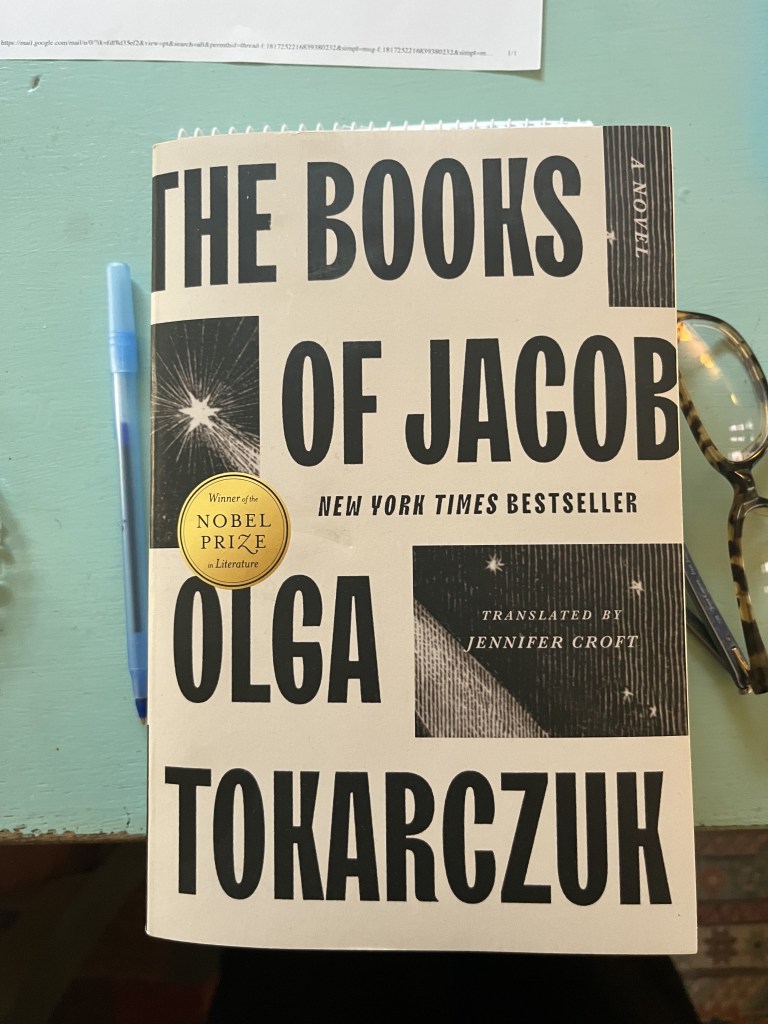
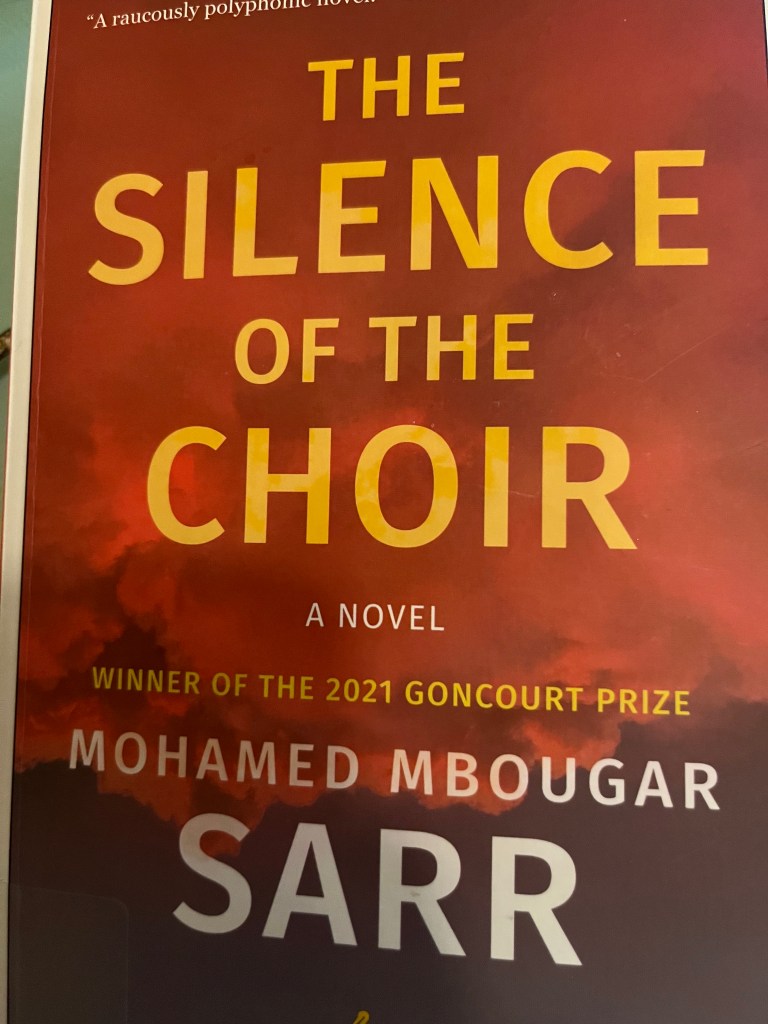
This year there are a lot of books I’ve read and really enjoyed. The one I’ve pictured here is one of them, but I also want to point out “The Minotaur at Calle Lanza” by Zito Madu, “The Message” by Ta-Nehisi Coates, “Riwan” by Ken Bugul (in French) and “The Silence of the Choir” by Mohamed Mbougar Sarr. All are wonderful and illuminating. Great books to keep me thinking! I highly suggest a read! The Books of Jacob is an amazing labyrinth of a story that takes place in mid-19th century Poland and in a magical realism kind of way tells the story of a Jewish community there. In keeping with the labyrinth theme, the Minotaur at Calle Lanza is a fantastic story of self-regeneration that involves a Nigerian-American from Detroit and the city of Venice. Bugul and Sarr are from Senegal. “The Message” is an exploration about land, home, and competing histories, among other things – addressing Blackness and our own problems of, and readings of, home and history. Treat yourself well and do some reading to compliment your internet browsing, if nothing else. I am purposefully keeping my book reading going as a discipline against being unable to read a book at all, due to excessive screen time. It’s real.
Otherwise, I’m working on being more regular with meditation and exercise. I am enjoying cooking and I’m enjoying my students at the private liberal arts college where I teach.
What does any of this have to do with being Black in the African Diaspora? First, all of these books have important ideas about marginality, dreaming for a better world, and internal struggles we all have with ourselves. Second, my writing project (reveal!) is a memoir with social commentary on the African American elites of the 20th century who were clustered around Howard University. More coming on that!
Have you noticed much attention to a possible correlation between the corporatization of health care in this country and diminishing confidence in the delivery of medical services that we are seeing today? Me either. Yet, the occurrence of one in parallel to the other should not be dismissed. From my own experience, I have seen one health services corporation in my area literally swallow every other service in the sector.. no doubt under the guise of ‘increasing efficiencies.’ When I go to the pharmacy, the number of bags waiting for customers is astounding and unsettling. Are we all that ill? I wonder. I have seen prescription bags multiply – as if self-replicating – since that medical corporation has settled in.
Don’t get me wrong. I’m enormously thankful for the sophistication and accessibility of our medical systems. I am thankful to be in a country where such services are available, especially if one has health insurance. However, one can’t help but notice that the more you have health insurance, the more tests are suggested, the more medications are recommended, the higher number of surgeries that are possible and often pushed.
Part of the answer to the public refusal of vaccines and suspicion of government in general can, unfortunately, be laid at the feet of the great marriage between doctors and the pharmaceutical industry. I don’t much blame the doctors, though. They were ambushed some thirty years ago and put into vassalage by the increasingly powerful and ubiquitous Big Pharma. I don’t totally blame Big Pharma, either. It is wonderful what well-financed medical and other scientific research can bring to society, and I wouldn’t want to see that end.
BUT. When people see themselves aggressively targeted for medical services, some of which they haven’t even dreamed of, believe me that at some level, conscious or unconscious, they know it is not all about an altruistic concern for their health. The bonding of medical services with private, corporate approaches to service is disastrous in ways that many have not noticed. The medical professions loses CREDIBILITY when their work is more tied to a profit motive than to a healing and service approach. Hard for the public to believe that it is all for their own good! It is starting to feel vaguely predatory. No wonder people are suspicious of vaccines.
Pushing medications, services and sign-ups to un-necessary networks, newsletters, and announcements leads the public to see themselves as the ‘mark’ they are in this process. So I’m suggesting here that the work ahead of us is more than even simply changing the payment system and organization of our health insurance. I also urge us all to reflect, really, on what services are or are not really necessary. This year I had two tests ordered for me without my knowledge that I didn’t need and didn’t ask for. I caught this in time, but I get it. Everybody wants to make their dollar out of the deal. Why is it that we have so much medicine circulating around and as a nation are so much sicker than most other industrialized northern nations?
We need lifestyle changes, and we need to figure out how not to be marks in a predatory health care delivery system, or change it. What do you think?
What is it about joy? We cannot force it, but we all hope for it. We cannot wish it into existence; sometimes we don’t know what exactly brings it to us. It seems to me, though, that joy is often quietly abiding in community.
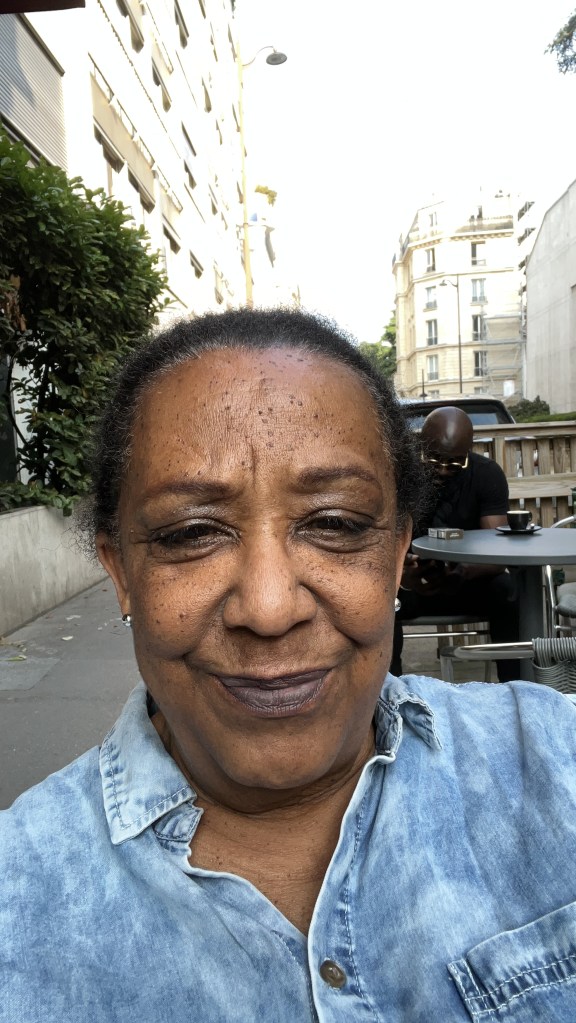
Having spent the last few days in a fairly rural part of southern France, I was struck by what I perceived to be simple manifestations of joy. I don’t mean my joy, although I was certainly happy to be there. What I mean is the contented aura of the many people milling about in a small town square who appeared to have something to do. The square had a small fountain in it. Despite what financial austerity the community, the region, or the country might be facing, water was running in the fountain. It was sunny and warm. People greeted each other and even me, obviously a stranger. It was a Saturday. Children were going by with parents, teenagers wandered around in small groups or in pairs. Some appeared to be coming from or going to school. The fountain water glittered in the sunlight. Smallish cars and the occasional motorcycle zoomed past on the nearby main street. The streets were clean. Men and women of all ages were sitting at cafes, together or by themselves. Everyone – save a very few – was dressed well. By that I mean they appeared to be clean and neatly dressed. There didn’t seem to be any strain to achieve the latest fashion; rather, just an inclination to look as well as one might without too much effort.
All around me people chatted with intention and animation. Some were laughing. Some appeared to be discussing something serious. Others seemed to be enjoying delicious gossip. At each café (they are closely situated, one after the other) clients chatted with the waiters and waitresses as well as each other. If I were to search for a way to describe the quality that I felt pervaded among the people, I would say that there was an absence of effort. There seemed an absence of effort to be observed, to be admired, to be heard or to be included.
I think there is something about community that allows joy to manifest. It is tied to security but it isn’t just security … security might be one of the most boring things about such a place. Maybe it’s reliability. By that I mean the reliability of the social contract, of knowing folks in one’s community, of sharing routines and practices. I believe these conditions allow for the multiplication of opportunities for small joys.
This is not an essay that addresses the social ills of France, of which there are many, especially in the big cities. What I want to bring up here is the sense that people – in this small town – seemed to feel the right to be joyful. Also the right to the pleasure of being old, or young, or short, or tall, the pleasure of being alive. I tried to imagine this sort of abandon in a small American town but it was difficult.
What have we done? Somehow we have capitulated to despair and unease, dissatisfaction and wariness of each other. We are not sure we deserve beauty in our surroundings, or what beauty might signify for us. We seem more secure in measuring our differences, our displays of wealth, or not; or our indifference to aesthetic pleasures. Underneath, there is a steaming anxiety that everything we have is not enough. We are more preoccupied with the material belongings we can count (or think we should have). Objects, more reliable, ease our active judgement of one another. With such a measured life, maybe there is less likelihood of the accidental and the coincidental. We leave insufficient space for joy in the social fabric we have so tightly woven.


 blackintheafricandiaspora.blog